A radio reply is evidence. It isn't proof.
A crew answering “copy” on the radio is evidence. It isn’t proof.
In a fire incident, that difference matters. Radio traffic, CCTV, and sensor readings arrive separately, at different times, with different levels of reliability. The operator doesn’t need another chat window that sounds confident. They need to know what changed, what was acknowledged, and what is still unknown — and they need to be able to check.
So on 12 September, at the Agents, Everywhere hackathon hosted by AI Tinkerers Valencia at Base 2, La Marina de Valencia, our team JSLab built Fire Incident Copilot — and it was selected as a finalist in Valencia, out of 19 submitted projects.
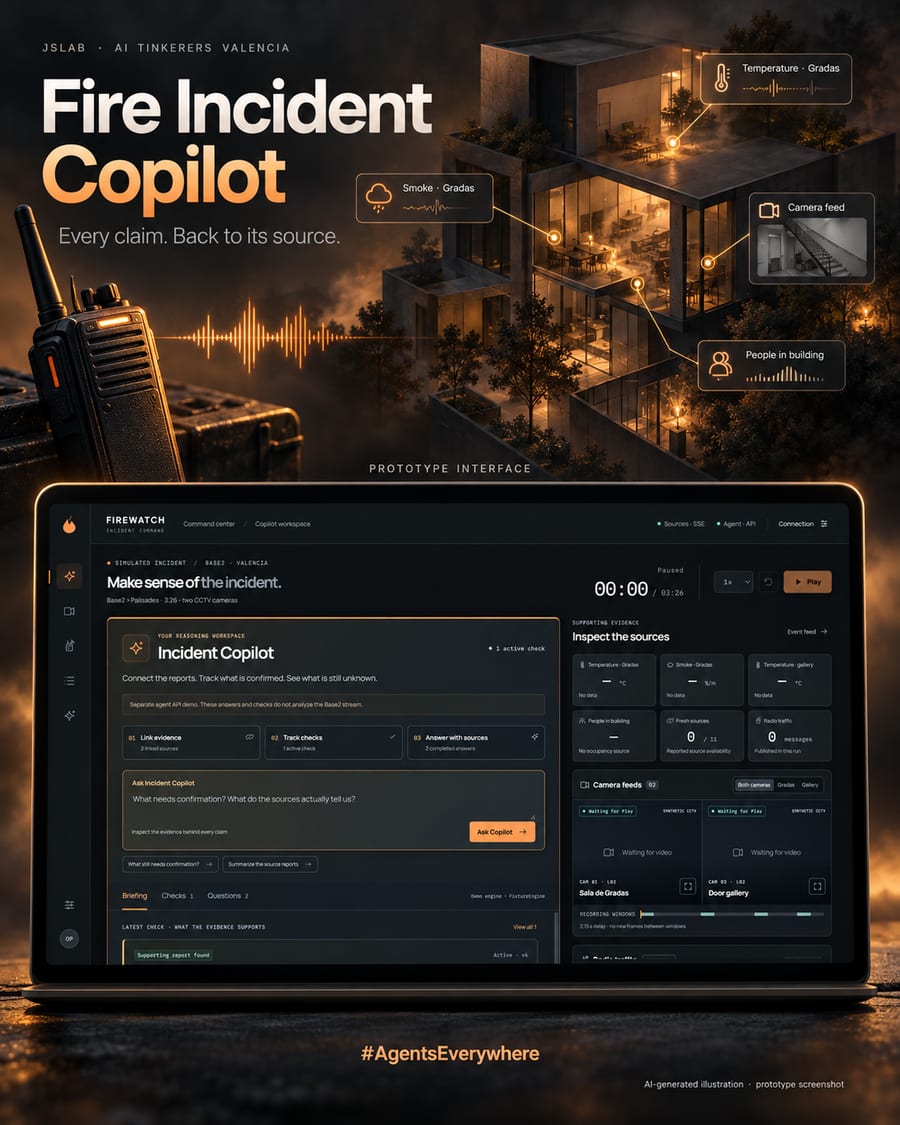
Cover: AI-generated illustration with the prototype interface.
What it does
Fire Incident Copilot puts an evidence-aware assistant into the operator’s workspace, right beside a replayable incident timeline:
- One timeline for every source. Radio audio with timestamped transcripts, CCTV, and building sensor readings, replayed together.
- Background checks. The agent keeps an evolving evidence card up to date as the incident unfolds.
- Answers with receipts. Ask a question and you get structured claims, each linked to its sources, plus explicit limitations.
- Continuity. The assistant works with the incident’s own sources, timeline, and accumulated state, so the operator never has to rebuild context in a separate chat.
The line on our cover says it best: every claim, back to its source.
”Was the channel assignment acknowledged?”
We built the demo around that one question, and it ended up being the most useful design constraint we had.
The agent follows a radio exchange from the request to the channel assignment to the reply. That reply is real evidence that the assignment was acknowledged. It does not prove that every crew actually switched channels. A system that squashes both into a simple “yes” is quietly making the operator’s call for them, with a claim nobody can defend.
That distinction shaped the agent logic and the interface. Every inference carries source chips. Limitations get their own box, and they never silently disappear.
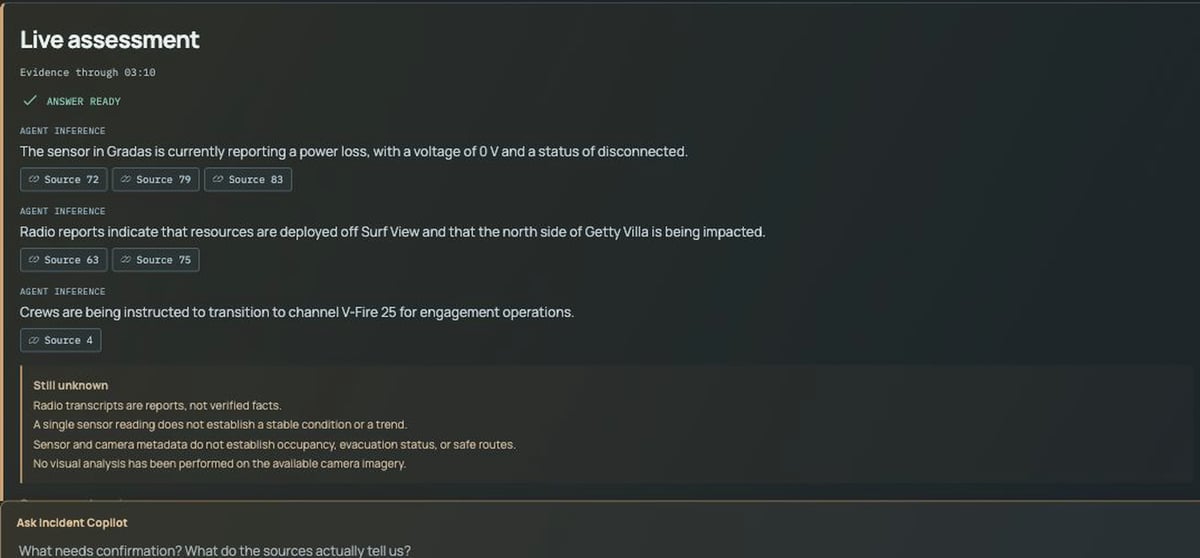
Look at the “Still unknown” box. Radio transcripts are reports, not verified facts. A single sensor reading doesn’t establish a trend. Sensor and camera metadata don’t establish occupancy, evacuation status, or safe routes. No visual analysis was run on the camera imagery. It’s honest by design, and that’s the posture I want from any tool that sits next to a human decision.
What’s real, and what isn’t yet
I’d rather be precise than impressive:
- The demo combines a 206-second archival Palisades radio excerpt with separately labelled synthetic building sensors and CCTV. It is not one real historical incident. Audio provided by Broadcastify (CC-BY-3.0-US).
- Radio transcripts are prerecorded, not live speech recognition.
- Replay, media delivery, and dashboard interactions were verified with a deterministic agent test engine. Agent SDK and LLM provider integrations are implemented, but we did not verify end-to-end live-model behaviour or semantic accuracy.
- Research, dataset work, and an early local simulator existed before the event. The hackathon is where it all came together into one working prototype.
It’s a decision-support prototype, and a human operator stays in control.
The team
- Anastasiya Nikiforova: operator experience & dashboard
- Artem Koziukin: agent service & model integration
- Vitalii Ionov: team lead, simulation & source data
- Vitalii Nechitailo: telemetry platform & data APIs
My part was coordinating the team and building the simulation and source-data environment: dataset prep, deterministic replay, timestamp and provenance handling, SSE state delivery, continuous audio/video streams, and deployment. I also put together the Blender building scenario and the synthetic CCTV assets, which were made with AI tools. The stack, briefly: Python and FastAPI services, a PostgreSQL-backed telemetry platform with REST, SSE, and MCP access, and a JavaScript dashboard that uses MediaSource for continuous playback.
See it
- aitinkerers.space: the project site
- Demo video: the two-minute walkthrough
- Source code: repo and documentation
- Official entry at AI Tinkerers Valencia
If you work in incident command or dispatch, I’d really like to hear what’s missing from our “still unknown” list.
Fire Incident Copilot — Finalist, Agents, Everywhere hackathon, AI Tinkerers Valencia, September 2026. Built by JSLab.